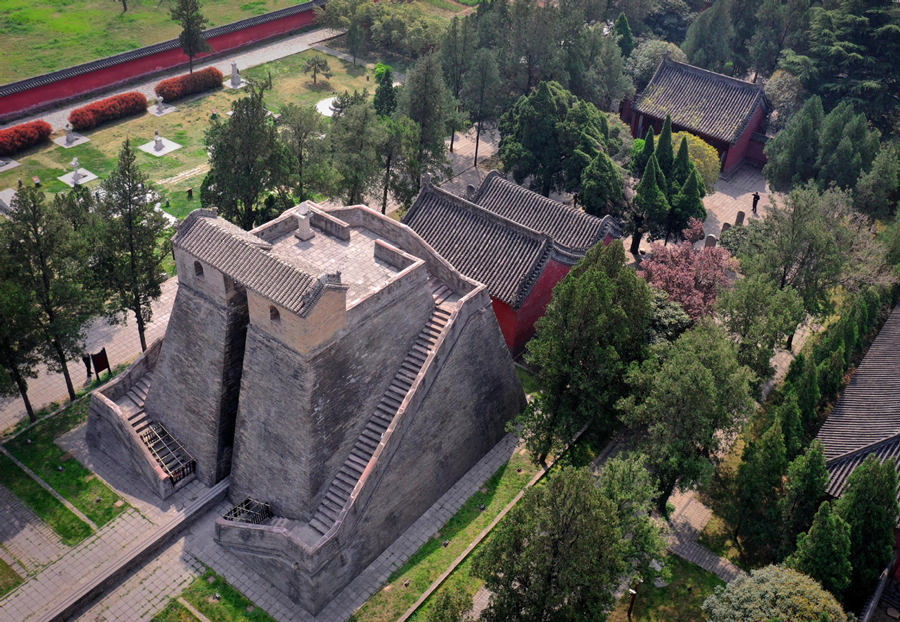
Astro Observatory in Dengfeng, Henan
Introduction
Astro Observatory in Dengfeng county, Henan province, is a prominent ancient astronomical structure situated in Gaocheng town, approximately 15 kilometers southeast of Dengfeng. It is part of the historical monuments of Dengfeng, often referred to as "The Center of Heaven and Earth", a UNESCO World Heritage Site.
This observatory is recognized as the largest ancient observatory now existing in China and holds significant historical and scientific value. Constructed during the Yuan Dynasty (1271-1368) in 1276, the observatory embodies the advanced astronomical knowledge and architectural skills of its time, serving as a crucial tool for celestial observations and time measurements.
History
Early Development
The Astro Observatory in Dengfeng was commissioned in the 13th year of Emperor Zhiyuan's reign during the Yuan Dynasty, under the direct supervision of the renowned astronomers Guo Shoujing and Wang Xun. This period marked a significant advancement in Chinese astronomical practices, as the observatory was one of the 27 observation stations established across China. Its construction signifies the importance of astronomical research and its integration into state governance and scientific inquiry at the time. The observatory was meticulously designed to feature a stone gnomon, utilized for measuring the sun's shadow, observing celestial bodies and maintaining accurate timekeeping, reflecting the era's scientific advancements.
Major Renovations
Throughout its history, the Dengfeng Observatory has undergone various phases of renovation to preserve its structural integrity and scientific functionality. Recognized as a Key Cultural Relic under State Protection in 1961, the observatory has been the focus of numerous conservation efforts aimed at maintaining its historical and educational value. These renovations have ensured that the observatory remains a significant cultural and scientific monument, providing insights into the technological and scientific accomplishments of ancient China.
Architectural Features
Design and Structure
The architectural design of the Dengfeng Astro Observatory is a testament to the ingenuity and scientific prowess of ancient Chinese civilization. The structure is primarily composed of masonry, embodying a robust and durable form. The observatory stands at an impressive height of 12.62 meters, with a unique square plane design that features a narrower upper part and a broader base. On the northern side of the observatory, two symmetrical step entrances facilitate access for observational purposes. The architectural highlight is the central northern wall, which is ingeniously constructed with a hollow groove, allowing for precise measurements of the sun's shadow.
Notable Instruments
Central to the observatory's function is the stone gnomon, an ancient astronomical instrument used to determine the length of the sun's shadow. This gnomon apparatus is ingeniously connected with 36 blocks of blue stone, extending over 31.2 meters in length and 0.53 meters in width. The gnomon is equipped with parallel two-way watercourses, designed for levelness measurements. These watercourses are complemented by a suction sump to the south and a discharge sump to the north, each fitted with precise scales. Such intricate design elements underscore the observatory's role as a pivotal scientific instrument in ancient astronomical practices.
Scientific Contributions
Astronomical Discoveries
The Dengfeng Astro Observatory has played a crucial role in furthering astronomical discoveries in ancient China. As one of the key observatories of its time, it enabled significant advancements in the understanding of celestial movements and time measurement. The precise shadow measurements facilitated by the stone gnomon allowed astronomers to accurately track solar and lunar cycles, contributing to the development of calendars and enhancing the agricultural planning and socio-political governance of the period.
Research and Studies
The observatory served as a research hub for ancient astronomers, who conducted extensive studies on celestial phenomena. The data collected from the observatory's instruments provided crucial insights into the dynamics of celestial bodies, influencing astronomical theories and practices. These studies laid the foundation for future astronomical exploration in China, cementing the observatory’s reputation as a center of scientific excellence and innovation.
Preservation Efforts
Ongoing preservation efforts are crucial to maintaining the integrity and historical value of the Dengfeng Astro Observatory. These measures include structural restorations, environmental management and the implementation of modern conservation techniques. By preserving the observatory’s original features and ensuring its stability, these efforts contribute to the site's longevity and educational value.
Future plans for the Dengfeng Astro Observatory involve enhancing its role as a center for education and cultural exchange. Initiatives may include the development of interactive exhibits, collaborations with international astronomical organizations and the promotion of the observatory as a symbolic link between ancient astronomical practices and modern scientific inquiry.








